• 021-27457
  • Iran, Tehran, Pasdaran, Fourth Neystan St, Building No. 7, Unit One

Extended Aeration Method

Introduction

One of the types of activated sludge process is extensive aeration treatment, which can also be considered as a modified type. This process has undergone changes over the years but has always been more welcomed than other methods. This method works by using the complete mixing method or creek in the wastewater treatment process. Wastewater treatment packages that are made using this method are very suitable for small communities and places that face the problem of sufficient space to build a treatment plant.

In this regard, Mojan Company has provided the necessary facilities for wastewater treatment in portable packages. These packages, which use the activated sludge method with continuous aeration as biological treatment, are made with the aim of treating human wastewater and in order to access high quality treated and disinfected effluent. Mojan wastewater treatment packages, using reliable design and quality equipment, are used in the incoming wastewater with a capacity of 10 to 75 cubic meters. The treatment process in Mojan fabrication packages mainly includes the stages of debridement, aeration, sedimentation, sludge storage tank and disinfection of the treated effluent. The purification packages are fully assembled from the company’s factory, transferred to the installation site and are ready to work. The tanks are made of structural steel and are properly covered with plastic document to resist corrosion of surfaces in contact with sewage.

Process description

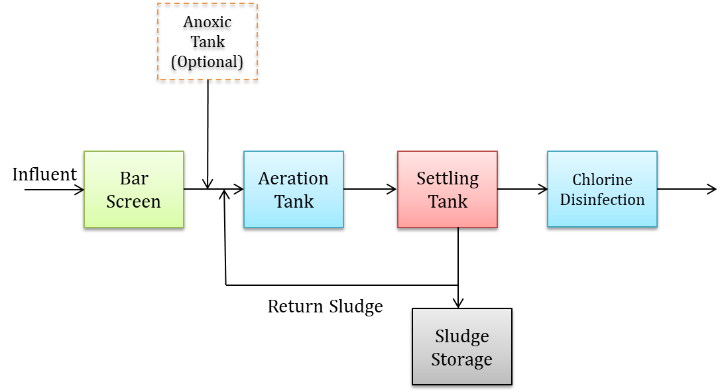
Raw wastewater, when entering the package, is directed to the garbage collection section and from there enters the aeration unit. In this way, the BOD content of the wastewater is reduced with proper retention time and aeration. Then, when the flow enters the sedimentation unit, the treated effluent is separated from the sludge. Afterwards, the treated effluent is transferred from the sedimentation unit to the chlorination unit so that it can be discharged without polluting the environment. Part of the sludge is transferred to the aeration unit to increase the filtration efficiency and the other part goes to the sludge storage tank. The dimensions of the tanks as well as the flow rate inside the packages will be designed and selected based on the flow characteristics of the incoming sewage.
MBR method

Process description

In this method, using semi-permeable membranes, biological separation of sludge and decomposed materials is done by filtration. The cell mass formed by filtration itself removes the contamination. The main reactor in this project consists of two main parts, aerobic and anaerobic, which removes nitrogen from the wastewater. The sludge from the separation of wastewater by membranes and filtration with a concentration of 8000-1500PPM causes a very high efficiency of the system and the removal of carbon and phosphorus and nitrification and denitrification is completely done so that it can be said that the effluent is almost treated. It is free of any bacteria. One of the main advantages of this method is that it takes up very little space compared to conventional wastewater treatment methods.


Applications and advantages of MBR method:


1- Sanitary sewage

  • Use of MBR package due to limited space
  • Use the MBR method when the contamination load is excessive
  • Possibility of reusing the treated effluent


2– Industrial wastewater

  • Ability to reuse treated wastewater
  • Occupy little space
  • bility to remove wastewater chemicals with high pollution load
  • Ability to remove non-removable suspended solids

MEMBRAY flat and submersible membranes in an MBR package have the ability to remove suspended particles. This advantage, like microfiltration in the above membranes, has led to the widespread use of MBR packages. MEMBRAY membranes in such packages perform particle separation and help increase aeration efficiency. Each elm consists of a specified number of flat membranes that are fixed to each other on both sides by suitable retainers and also transported to the storage section by a treated effluent pipe. The aeration section also includes a diffuser and a deep aeration method.


Technology of using MBR method in wastewater treatment

The use of membranes causes the separation of sludge from the effluent, in which case the very high quality of the treated effluent is one of its main advantages. This effluent is similar to the reverse osmosis method in water treatment and the treated effluent can be drunk after passing through an RO system. Membranes in this method have the ability to produce activated sludge with a very high concentration and in this operation, they remove BOD and nitrogen with high efficiency. The design and assembly of the Germans is such that the blocking action does not occur in them and high quality effluent is extracted.


Other uses:

Membrane-containing elements can be installed in an activated sludge system and biologically treated. In this case, the sediment part in the above system is removed and high concentration sludge is formed. This reduces the volume of packages.

Because flat membranes are more resistant to fouling than fibrous membranes, they require less chemicals for washing. These membranes also remove very small objects (about the diameter of a human hair), and there is no need for fine contaminants in these systems.


energy consumption:

MEMBRAY membranes consume less energy than other fibrous membranes. This is due to the high efficiency of aeration of packages and the reduction of fluid pressure drop across membranes.


applications :

Packages made by Mojan Company with the removal of BOD and COD contaminants as well as nitrification and denitrification in different types are used for wastewater treatment. Some applications of these packages are:

  • hospitals
  • Hotels and ..
  • Dairy and canned food factories
  • Paper and pulp mills
  • Drug and chemical factories
  • Factories for the production of carbonated beverages and fruit juices
  • Military camps
  • Sports camps
  • Tall buildings and towers
  • Airports and terminals
  • Prisons
  • Small towns and villages

MBBR method

MBBR (Biofilm Mobile Bed Reactors) processes are one of the most effective biological processes in wastewater treatment that are based on activated sludge process and biofilter processes. Two common technologies most commonly used in biological wastewater treatment are activated sludge and drip filters. MBBR processes are a combination of both types of technology.

The community of microorganisms that grow on surfaces is called a biofilm. In MBBR technology, a biofilm that grows protected inside packages with an engineering design and a high surface-to-volume ratio is completely suspended and in constant motion in the liquid phase inside the reactor, decomposing the contaminated material. they do. These contaminants, which must be removed for wastewater treatment, are in fact the food needed for biofilm growth. Therefore, it is important to design the packings so that they can perform the function of transporting food and oxygen required by microorganisms. Excess biofilm produced in this method also separates naturally from the surface of the packings. Packings are usually made of compressed polyethylene, the specific gravity of which is close to the specific gravity of sewage.

The engineering design of the reactor aeration system makes it possible to supply the required oxygen to the wastewater and on the other hand to supply the mixing energy necessary to keep the packings immersed and to mix them throughout the tank. The aerated sewage leaves the aeration reactor by passing through a mesh plate that prevents the packings from leaving. In order to remove the biofilm separated from the packages from the aerated wastewater, a sedimentation unit is used after the aeration unit. The next stages of treatment are similar to the usual methods of wastewater treatment.

This technology takes advantage of the activated sludge method and fixed film systems, without affecting the disadvantages of the two. MBBR reactors are able to have good efficiency against high levels of pollution in water. Also, the treatment process in them is less effective than noticeable changes in water parameters.


Advantages of the MBBR process

  • Compact operating units with smaller dimensions
  • Ability to increase filtration capacity by adding media packing
  • Complete removal of solid particles
  • Improved sediment characteristics
  • Perform biological process in the presence of high dispersion density suspended biomass particles
  • Increase process stability


Process diagram and inventory units in prefabricated wastewater treatment package

Specifications of incoming and treated wastewater by prefabricated package

Parameterthe unitThe average valueMaximum valuetreated wastewater
Sewage temperatureC25-1035
BOD concentrationMg/L300-25045030>
COD concentrationMg/L500-30065060>
Suspended solids concentration (TSS)Mg/L350-20040040>
Total nitrogenMg/L45-305040
PH9-69-6

UASB method

Introduction

Most conventional treatment plants, in addition to significant space and energy consumption, have high investment costs and operation. On the other hand, the operation of these refineries requires skilled personnel. In recent years, modern wastewater treatment technologies have been developed with the aim of achieving high quality treated wastewater and eliminating the shortcomings of conventional treatment plants. Among the recently developed technologies, UAS packages have been widely used for the treatment of industrial wastewater containing high concentrations of organic matter (wastewater with a BOD of more than 1000 mg / l). Mojan Company, using the latest technological achievements, has built UASB portable treatment systems for biological treatment of industrial wastewater.


Description of the UASB process

In UASB packages produced by Mojan Company, a bed of sludge is formed in the bottom of the UASB reactor with the help of accumulation of solids and the activity and growth of bacteria. All biological reactions take place in the part that contains the sludge. Sewage enters the reactor tank from the end through the sewage distribution pipes and moves to the top of the reactor through the anaerobic sludge bed accumulated in the bottom of the tank. A fraction of soluble COD is converted to biogas, which mainly contains methane gas, causing sludge and sewage to mix. In order to limit the high amount of sludge inside the reactor as water, sewage and gas flow upwards, separation devices are used to return the sludge to the reactor floor. Therefore, the sludge is granulated, the gas of which separates and returns to the bottom, which causes a circulation in the sewage stream at the bottom of the tank. The gas produced by the collection system installed on top of the reactor tank exits the reactor.

A special collection system is also used to collect gas that moves upward near the reactor walls. The upward motion of the produced gas mixes with the downward motion of the granulated sludge, which creates a constant rotational motion inside the reactor. This ensures efficient mixing of sludge and wastewater without the need for a stirrer, mixer and without spending extra energy inside the UASB reactor. While the sludge remains at the bottom of the reactor, the treated effluent, like the gas produced, exits the top of the reactor. Mojan UASB packages are made of steel and the components that are in direct contact with the wastewater, sludge and gas produced will be made of stainless steel.


Features of UASB packages

Some features of UASB packages made by Mojan are:

  • Low energy consumption
  • Low start-up and maintenance costs
  • No need for skilled personnel to lead and supervise
  • Energy recovery potential through electricity generation from biogas produced inside the package and also the use of sludge produced for agricultural purposes
  • Ability to treat wastewater with different discharge and COD content due to the use of modular design
  • Ability to adjust the pH of wastewater and add neutralizers to it if needed
  • Easy access to clean and inspect the device
  • No bad odor in the environment
  • Long shelf life

Application of UASB packages

Mojan prefabricated UASB packages can be used to treat various types of industrial wastewater. Some examples of the use of these packages are as follows:

  • Sugar industry
  • Paper industry
  • Fruit and juice processing industries
  • Food industry
  • pharmaceutical Industries
  • Beverage industry
  • Canning industry
  • Wood Industry